 Novel
Auren Huce Haushi ( Daren Dinner ) Book 3 by Maman Fateemah Latest Hausa Novel
Please login or register to access this premium novel.
NovelPlease login or register to access this premium novel.
At the door of the plane, Zahra’s father Abba seats her beside her aunt and Hajiya Kaltume and gives his instruction. She is to be handed to Alhaji Muhammadu, with the words “ga amanar ‘yata”. Then he turns and leaves. That is how this stretch of Auren Huce Haushi by Maman Fateemah (Aishat Isah Musah) begins. The bride is already married on paper. What she does not yet understand is the family she has married into, or how much of it is still hidden from her.
Before that flight, the story stays in her family’s house in Bauchi. Mahmud’s relatives arrive with the bridal gifts, and Zahra’s mother, Ammah, receives a set of car keys from his mother, Ammi, in thanks. Then Mama, a woman who looks down on the match, collapses in the parlour. At the hospital her blood pressure is found to be dangerously high, and she is sedated. Inna Maimuna watches all this and privately remembers Mama’s “mugun nufi” (bad intentions) in the earlier quarrel over Zahra’s marriage. The text does not say what those intentions were, but it keeps returning to them. Mama insists on being discharged and travels to Sokoto with the family anyway.
In Sokoto the novel changes scale. Sameer meets the plane, Mahmud’s sister Aishat greets Zahra with her small daughter Afnan, and Zahra is taken to Hajiya Inna, Mahmud’s grandmother. Mama, expecting a modest household, finds a house like a palace and a family that moves among wealth without remark. Her thoughts show how wrong she was, and she is deeply shaken. The people who had mocked Zahra for marrying an almajiri with no known origins are now overheard in the text, quietly rewriting their opinion. Mahmud’s life at Malam Bukar’s school, which the earlier pages presented as his whole world, begins to look like a chosen disguise. Zahra herself thinks he lowered himself in Azare.
Zahra’s own feelings are less certain than anyone around her assumes. She tells her aunt, Aunty Hasana, that she is afraid of her husband and of the intimacy of marriage. Aunty Hasana answers with brisk, worldly advice and some sharpness, and later, before the wedding night, with a long speech about keeping a husband’s attention. Her mother’s family, her friends and Mahmud’s female relatives give Zahra advice on all sides. Aunty Surayya warns her to be careful of the girls in the family who have their eyes on Mahmud, and not to eat or use gifts of food from them without checking. Mahmud’s own mother, Ammi, welcomes her warmly. Hajja, an older relative, jokes that Zahra is her rival.
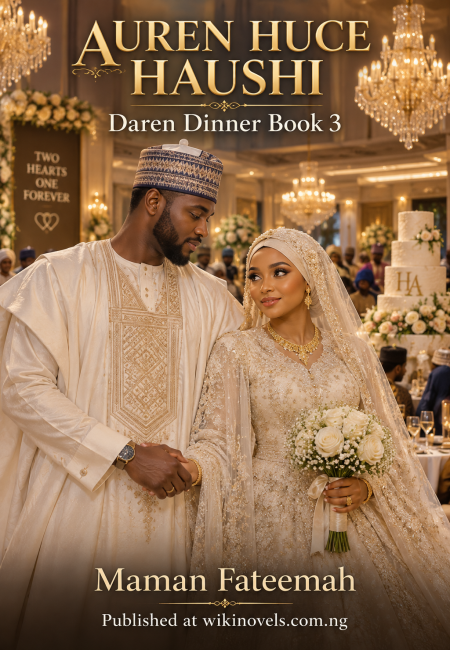
The central event of this section is the dinner at an event hall. Zahra arrives on Mahmud’s arm and is dressed twice, because he objects to the first gown. The money, livestock and jewellery that family members give her are described at length, and the text lists estate and camels among the gifts from Ummee, who appears to be on Zahra’s Arab side of the family. A speaker tells the story of how the couple first saw each other, and Zahra’s father recognises that they met on a flight. Among the guests is a Fulani woman from Damagaram, accompanied by a young woman. Zahra recognises her as the girl who stared at her and Mahmud at a train station in India. The girl watches her with a cold, withdrawn look.
That young woman is Haura’ul Insiyya. In a later scene she cries in her room, and her companion Salbiyya tries to calm her. Insiyya says she had been told, after the trouble that made Mahmud leave home, that a marriage with him might be arranged, and she has loved him for longer than she can say. Salbiyya tells her to let go, reminding her that Mahmud has shown the whole room that he loves his wife. Another woman, a doctor named Haseena, is mentioned by guests as someone who carried hopes of him for years. None of this is resolved. It simply sits behind the celebrations, along with Aunty Hasana’s quiet worry that her sister has walked into a family with its own old rivalries.
The nights and mornings that follow are written with tenderness and some humour. Mahmud is patient with a frightened bride. He feeds her, prays with her in Arabic and holds her through the night. Zahra, for her part, finds the man she knew as a poor student turning into someone she has to learn again. One morning she sees a phone call labelled “MY FIRST LOVE” and feels a sharp jolt of jealousy. When Mahmud answers it, he greets the caller warmly, and she finds he is speaking to his mother. The scene is small, but it shows what the novel is doing here: it gives Zahra a husband whose private life she cannot yet read.
What distinguishes this part of the book is its mix of celebration and unease. The wedding is lavish, but the people around it are watching, comparing and calculating. The Hausa moves easily into English words, which suits the way these characters live. The tone is warm, romantic and tense, closer to romance and family drama with a mystery thread than to a simple love story. It suits readers who enjoy large family gatherings and slow revelations, and who are comfortable with a Hausa and English mix. The intimate scenes are handled in the novel’s own way, so readers should expect adult marriage content.
The excerpt leaves several questions open. What exactly did Mama and others do to try to stop Zahra’s marriage? Why did Mahmud leave home, and why did he choose to live as an almajiri in Azare? What is the history between Mahmud, Insiyya and Dr Haseena? How does Zahra’s Arab family connect to Mahmud’s, and why did his own household not know of her until he showed them? And will Zahra, who now owns a house named for her, learn to trust the man who gave it to her?
A bride is welcomed with gifts from every side, yet the one thing she wants most is to understand the man she has married.
Zahra and Mahmud’s story is available to read on Wikinovels.com. If the wedding is only the beginning, who in his family will test it first? [https://wikinovels.com.ng/]