
 Novel
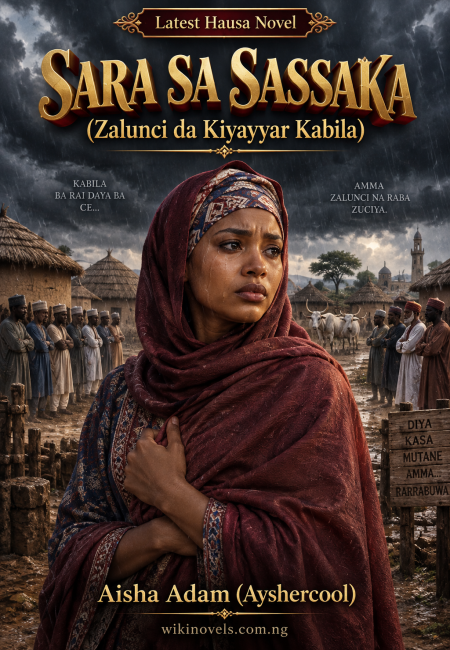
Sara Sa Sassaƙa ( Zalunci da Ƙiyayyar Ƙabila ) by Aisha Adam (Ayshercool) Latest Hausa Novel
Please login or register to access this premium novel.
NovelPlease login or register to access this premium novel.
A young man lies helpless in the rain, his body covered in blood, while the people who have attacked him insist that he deserves no mercy. His family can only watch as their pleas are ignored and the authority of one powerful household turns an entire community against them. For the young woman who witnesses the horror, the death of her brother is more than a personal tragedy. It is another painful reminder of the injustice her people have endured for generations. This is one of the disturbing realities introduced in Sara Sa Sassaƙa by Aisha Adam, also known as Ayshercool, a Hausa novel that explores insecurity, ethnic hostility, abuse of power, family struggles and the consequences of long-standing hatred.
The story opens on a stormy night, with a man leading a young boy away from a village. The rain has not yet fully begun, but the sky is already filled with thunder and lightning. The man knows that the boy must leave before daylight, because remaining in the area could put his life in danger. He gives him his belongings and some money, urges him to find somewhere to hide from the rain, and tells him to keep moving. The boy does not want to leave the man behind, but he understands the danger surrounding them. Before they part, he makes a promise that carries the weight of pain and determination: he will return one day, although he cannot say when.
The narrative then shifts to a tense political atmosphere. The country is waiting for the final announcement of a presidential election result, while a state of emergency has left the streets unusually quiet. Security vehicles move around as residents remain indoors, following developments through their radios, phones and televisions. Behind the public uncertainty, however, another kind of political calculation is taking place. An influential elderly man is meeting with other powerful figures, discussing how to make life difficult for a political leader who has gone beyond the limits they expected him to observe. They believe that although they helped put him in power, they should still control the direction of his government. Their proposed method is to use insecurity and fear to put pressure on him. The discussion introduces a troubling picture of political manipulation, where the safety of ordinary people may become part of a much larger struggle for influence.
From there, the story moves into the history of a rural community called Yelwa, where the narrator describes the painful divisions between the ethnic groups living in the same area. Although several communities once shared the settlement, differences in population and strength have allowed one group to dominate the others. Some people have already abandoned the town and established settlements elsewhere, leaving the remaining communities to live under an atmosphere of intimidation and unequal treatment. The narrator describes this hostility as something inherited from parents and grandparents, a burden that younger generations have grown up carrying without fully understanding how it began.
The arrival of the rainy season usually brings happiness to farmers and herders. The land becomes green, crops begin to flourish, animals have access to water and the community prepares for the benefits of the season. But in Yelwa, the rain also brings back painful memories. For the narrator, the darkening sky is not simply a sign of approaching rainfall. It recalls the fear and violence that have repeatedly affected the people of the village.
One evening, the narrator notices her father, Baffa, moving anxiously around the house and asking after her brother, Iro. Iro has recently returned from spending four months away with the family's cattle, and he has been home for only two days. Before leaving the house, he had spoken cheerfully with the narrator, telling her to look after a cow that appeared close to giving birth. He had promised to share stories with her when he returned. Now, however, the hours are passing, and he has not come home.
Baffa searches for him but returns without finding any trace of his son. Soon, noise begins to approach their home. The family rushes outside and discovers a crowd carrying sticks and torches. At the centre of the gathering lies Iro, badly beaten and covered in blood. His father desperately asks what his son has done to deserve such treatment, but Saleh, one of the young men leading the crowd, responds with hostility rather than an explanation.
Saleh accuses Iro of attempting to sexually assault a girl from his community. The narrator is convinced that the accusation is false, and she cannot understand how a young man who has spent months away from the village could have committed the offence being described. Yet the crowd does not give the family an opportunity to explain or challenge the allegation. Iro is dragged across the ground, beaten again and tied to a tree as an example to anyone who might be accused of a similar offence. The attackers also order that the family's cattle be taken as compensation for the alleged wrongdoing.
The family's neighbours attempt to intervene, asking Saleh to allow the matter to be discussed and settled peacefully. Their pleas are rejected, and anyone who challenges his decision is threatened. Even the narrator's attempts to reach her brother are stopped. As the rain begins to fall heavily, the family is left with no way to protect Iro. They spend the night in grief and fear, waiting for a chance to reach him.
By morning, there is no sign of life in Iro's body. Yet the humiliation does not end with his death. Saleh returns with his followers, orders that Iro be untied and tells Baffa to bury his son outside the village. He refuses to allow the body to receive the proper treatment and burial that the family believes a Muslim deserves. The narrator, who has been holding back her anger, finally kneels before Saleh and begs him to show mercy. She appeals to their faith and asks that Iro be buried according to religious requirements, whatever accusation has been made against him. Saleh responds with laughter and contempt, reminding her of an earlier promise she had made against him and using the family's vulnerable position to deepen their humiliation.
Baffa is eventually forced to take his son's body away, while the people around them remain too afraid to challenge Saleh. Even the narrator's extended family members, who approach Saleh's father for help, return without justice. His father supports his son's actions and maintains that Iro was caught committing the alleged offence. For the narrator, the incident becomes another wound added to the long history of oppression her community has endured. She remembers Iro as a careful and protective brother who constantly advised her to avoid trouble, especially because of her own difficult relationship with Saleh. Now that Iro is gone, she begins to think about the unidentified girl at the centre of the accusation and makes a private promise that her brother's blood will not be forgotten.
The story then introduces another young woman, Alina, whose everyday life is marked by school, family affection and an unsettling experience she does not know how to explain. After leaving her Islamic school one afternoon, she notices a strange-looking man following behind her. At first, she assumes he may simply be walking in the same direction, but repeated encounters make her increasingly afraid. She sees him near her route home, outside her neighbourhood and eventually close to her school. His appearance and persistent presence leave her wondering whether he is deliberately following her.
Alina tells the women in her household about the man, but her first concerns are not taken very seriously. Her sister-in-law jokes that perhaps he is a young man interested in her. Alina strongly denies this and worries that her older brother, Ismail, will misunderstand the situation. When she eventually tells him, however, he becomes angry and goes out with her to confront the stranger.
The man is sitting outside a small room, repairing shoes. Ismail approaches him aggressively, throws his tools aside and demands to know why he has been following his sister. The stranger denies following Alina and explains that their paths have simply crossed. The owner of the property then comes out and reveals that the man is an Almajiri who has recently arrived in the area and has been allowed to stay in an unused room that once served as accommodation for security guards. He describes him as a Qur'anic student and insists that he believes the young man will not harm anyone. Although Ismail eventually releases him, the confrontation leaves Alina feeling uncomfortable. She begins to regret telling her brother because she believes the stranger has been humiliated in front of the neighbours.
Alongside these events, the novel follows Ramata, a young woman whose education makes her stand out in a community where opportunities for girls are limited. She helps with household work and caring for animals, but she also has ambitions that extend far beyond the village. Her grandfather, Baffa, is proud of her academic achievements and hopes that she will continue her education. He believes that her knowledge may one day help bring a solution to the problems facing their community. However, the hostility between the groups in Yelwa has made education itself a source of suspicion, and he worries that Ramata's progress could attract unwanted attention.
Ramata shares a close bond with Bukar, a young man from the community with whom she has developed feelings. Their relationship is complicated by the divisions between their families and communities. Ramata understands that the hostility surrounding them may make marriage difficult, especially because people already judge her for attending boarding school and remaining unmarried at her age. Bukar also worries that he may not be considered suitable for her because he has not received the same formal education. Ramata, however, refuses to accept that education should become a condition for love or marriage. She believes that what matters is a person's character and the values they uphold.
Their conversations reveal the emotional cost of living in a place where old disagreements continue to shape personal choices. Ramata wants to pursue her ambitions without abandoning the people she loves, but she knows that the conflict between their communities may stand in the way of the future she hopes to build. Her relationship with Bukar therefore exists alongside the wider struggle for peace and acceptance.
Another family introduced in the excerpt is that of Harisu, a soldier who is the only son in his family. His father has died, leaving him responsible for his mother and three younger sisters. Although his salary has not yet been paid, he remains concerned about Naja's preparations to return to school. During a phone call, he reassures his mother and siblings that he will do what he can to support them. Naja, in turn, promises to remain focused on her education and make her family proud. Their exchange shows a household facing financial difficulties but holding on to affection, patience and hope.
Through these different characters and situations, Sara Sa Sassaƙa begins to build a picture of lives shaped by forces both personal and political. The injustice suffered by Iro, the fear surrounding Alina, Ramata's determination to continue her education and her complicated relationship with Bukar all point towards a community where ordinary people are forced to make difficult choices. The political discussion at the beginning adds another layer to the story, suggesting that insecurity may be more than a local problem when powerful people are willing to use fear for their own purposes.
The opening pages do not yet explain how all these characters and events connect, or what will become of the people caught in the wider conflict. The stranger who unsettles Alina remains an unanswered question, while the narrator's promise concerning Iro suggests that the injustice surrounding his death will continue to matter. Ramata's future with Bukar is also uncertain, particularly in a society where inherited hostility can become stronger than personal affection.
Aisha Adam, writing as Ayshercool and associated with Young Talented Writers' Association (YOTA 002) and Bright Pens, introduces the work as fiction. Her author's note explains that the story is not intended to insult any individual, community or institution, and that any resemblance to real people or events is coincidental. She also connects the subject of insecurity to the need to use creative works such as films and books to draw attention to the conditions affecting troubled areas. This intention is reflected in the serious atmosphere of the opening, where the experiences of ordinary families are placed against a background of fear, discrimination and abuse of power.
When injustice becomes part of everyday life, how long can a community remain silent before someone decides to challenge it?
Read Sara Sa Sassaƙa by Aisha Adam (Ayshercool) on Wikinovels.com and follow the lives of Ramata, Alina and the other characters as their stories unfold. Will the people of Yelwa ever escape the divisions that have shaped their lives, and will those who have suffered injustice finally find a way to be heard?


