 Novel
Noor Albi (Hasken Rayuwata) by Mamuhgee.txt
Please login or register to access this premium novel.
NovelPlease login or register to access this premium novel.
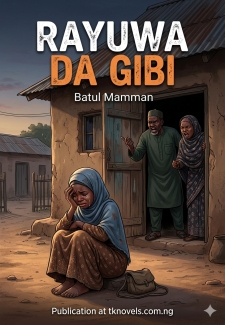
Zainab Laylah kneels by her father’s wheelchair and wipes spilled medicine from the edge of his shirt, and then tells him to stop seeing himself as the man who ruined his daughter’s life. If anyone must carry blame, she says, it is her, because her birth is what broke the household apart. That is how Noor Albi: Hasken Rayuwata by Mamuhgee opens. Nobody in that room has done anything cruel in front of her, yet the whole house is arranged around an old wound.
The father, called Abba and addressed in the text as Alhaji Mahmoud, has not walked for many years. He lies or sits where he is placed, and he cries without sound because his body no longer allows a sound. Laylah answers his tears the way she answers everything, quietly. She dries his face, holds his hand, and says that her mother did not die because of this story. In her view, her mother died because her time had come. Her calm is not an act. It is also not the same as peace, and the author makes that difference clear. The only thing that shows what Laylah feels is her smile, which the narrator says carries nothing but bitterness.
The reason for the silence in the house comes out through the narration. Abba secretly married a woman named Zainab, a distant relative of his closest friend, and kept the marriage hidden from his wife for six years. His wife trusted him completely and had a daughter with him, Sa’adah. Then Zainab became pregnant, and Abba was in a road accident while taking her to hospital in labour, in a state that was not their own. Abba’s wife, now addressed as Momy, learned of it only when she was called to the hospital. She saw Zainab’s body and a healthy baby girl. The baby was named Zainab after her mother, and Laylah is the name she goes by. Momy has never greeted her in the years since. Laylah greets Momy every morning anyway. She holds no grudge, and she explains the coldness as the natural result of what was done to Momy.
What Laylah wants is stated plainly in the text: to repay the people who took her in. She cooks, cleans and does the laundry, and she tends Abba’s room, medicine and bath routine. She wears clothes passed down from Anty Sa’adah and has never owned anything new. Anty Sa’adah, her half sister, is the one person in the house who treats her as family. It was Sa’adah who asked Momy to let Laylah go to school, and she often shields her without being asked. In the first episode she gently teases Laylah, saying nobody becomes a doctor by skipping meals, and then sits watching her eat. Laylah in turn loves Sa’adah more than anyone alive except Momy, whom she calls by that title and treats with complete respect.
Across the first three episodes the scenes are small and domestic: a plate of yam with red sauce taken from the pot, pure water from an old fridge, wheat and groundnut gruel fed to Abba with a spoon, a window opened so he gets air. These details carry the story. The plot moves forward through a hospital report. Dr Abbakar, the orthopaedic specialist who has treated Abba for years, tells him the results show an infection in his bones that has begun to reach his blood. He suggests that Abba reduce his worries. Abba understands what the report means for his remaining time. He is not afraid for himself so much as for Laylah, because Sa’adah will one day marry and leave, and he cannot imagine who will be left for his daughter. He thinks of one man he must ask, a friend named Turaki, and he knows the request is a heavy one to make given how far apart the two have grown.
What sets this novel apart in its opening is its restraint. Laylah never shouts, Momy never accuses, and Abba cannot speak much at all, yet every line of dialogue is loaded. The Hausa is formal and carefully measured, and the narrator moves between the characters’ thoughts and judges none of them. Momy is not made a villain. The text treats her cold manner as a grief of its own, and Sa’adah is shown as generous but limited, since her kindness depends on her mother’s money. The title’s tagline, “Rabo sai mai shi”, hints that fate is the real subject.
The author’s teaser on the cover page promises something the excerpt itself does not yet show. It speaks of a woman who never expected a certain man to matter to her, because she saw him as a father, her father’s friend and confidant, and of a love that grows between them even though both have forbidden it to themselves. It asks how she could look at the husband of a sister who held her the way a mother holds a child. None of that appears in these three episodes. What the excerpt does offer is the foundation: a young woman whose whole life has been defined by obligation, and a father trying to arrange her future before he dies.
The tone is serious, slow and emotional, closer to family drama and romance than to a lively love story. It suits readers who prefer character and atmosphere to fast plotting, and who are comfortable with Hausa written in a formal register.
The excerpt leaves many questions open. What exactly will Abba ask of Turaki? Who is Turaki to the family, and why is the gap between him and Abba so wide? Is the marriage between Abba and Momy still a real marriage, or only a household arrangement, as the narrator wonders? What will happen to Laylah when Abba is gone and Sa’adah marries? And who is the man the author’s teaser has in mind?
A daughter who accepts every blame has not yet been asked what she wants for herself.
Laylah’s story is available to read on Wikinovels.com. If Abba succeeds in what he plans, will it save her or bind her? [https://wikinovels.com.ng/]