
 Novel
Idon Naira (Hawayen Ya Mace ) by Mamuhgee.txt
Please login or register to access this premium novel.
NovelPlease login or register to access this premium novel.
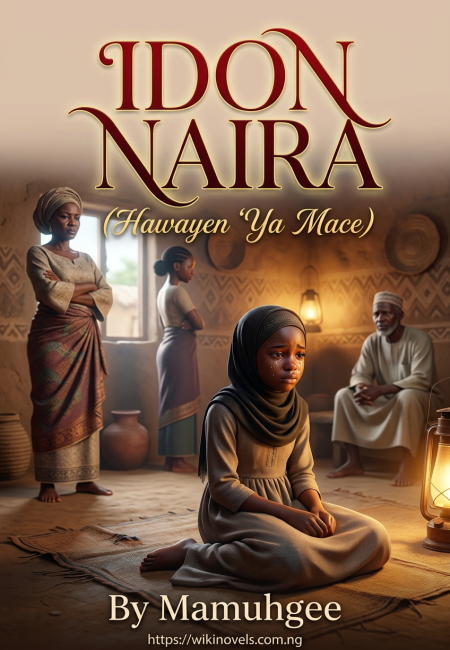
Hafsatu lies on her bed, one hand on a belly seven or eight months round, and is afraid. The love she feels for the child is real, but so is the dread of raising it in the house where she lives. In that house, her co-wife has never answered her greeting, and her husband’s daughter looks past her as if she were not there. That is how Idon Naira by Mamuhgee begins. The cover note names the novel Idon Nera in its own text, but the first thing the story gives the reader is this quiet, private fear. Hafsatu is carrying a child whose welcome she cannot count on.
The household belongs to Malam Adamu, a trader originally from Lokoja who now lives in Kano. His first wife is Hadeeza, the co-wife Hafsatu calls Anty Hadiza, who came from Cameroon and married him twenty-two years ago. They have one daughter, Maryamah, who is finishing a diploma in Business Administration. Hafsatu, a Fulani woman from Adamawa, married him two years earlier. She is an orphan who lost both parents when she was a baby, and Malam Adamu is the only family she has. Nobody in the house shouts. There are no quarrels and no insults. The cruelty is in the silence, in the way the two other women look at one another and then look away. Hafsatu thinks she would almost prefer a fight.
The excerpt is careful about what each woman wants. Hafsatu wants her unborn child to be loved, and above all hopes Maryamah, as an elder sibling, might one day stand in for a mother. Maryamah is described as a girl who feels strongly: when she loves something she loves it fully, and when she dislikes something she cannot bear to look at it. The author says she is devoted to her father and jealous of his new marriage, and that she has a deep dislike of the idea of “yan ubanci”, of sharing her blood with children by another mother. She is also well brought up, observant of her religion, and never rude to Hafsatu. Her mother, Hadeeza, tells her to ease up, yet the girl treats her feelings as a kind of nature. Malam Adamu sees all of it. He eats his meals watching his wives avoid each other, and he is unhappy that his home has no warmth.
The scenes are small and domestic: tuwo with okra soup eaten from a shared bowl in a silent parlour, a tired fan, a radio that Hafsatu switches on for company, and an elderly neighbour known as Iyah mai kosai, the only person who visits her. One errand shows the whole situation. Hafsatu asks Maryamah to fetch batteries from a nearby shop. Maryamah takes the money without a word, brings them back, and says only “Gashi!” Hafsatu thanks her, and the two return to their rooms.
The story then moves quickly. Hafsatu goes into labour at six on a Saturday morning and gives birth to a daughter who looks just like her. Malam Adamu holds the baby with trembling hands. At home, Maryamah looks at the newborn and feels, for no clear reason, something like destiny. Hadeeza wishes the baby well and leaves. The child is named Zainab, after Malam Adamu’s late mother. Iyah cares for mother and child through the weeks that follow, and when Hafsatu cries, she urges her to be patient and to see that the other two do her no harm, only keep their distance.
When Zainab is six months old, Hafsatu falls ill and dies in hospital. The excerpt does not say what the illness was. Malam Adamu cries with a grief the author says was worse inside than out. Iyah offers to raise Zainab until she is two or three, and he accepts. Years pass, and when Zainab is about two and a half, Iyah must go to her sick mother in the village, and the child is returned to Hadeeza’s care. Hadeeza accepts because she cannot refuse her husband, though she does so unwillingly. In the excerpt’s second episode, Zainab grows up in that house. Her father washes and feeds her each morning, and she is happy while he is home. Maryamah never holds her and never shows warmth or open dislike. Hadeeza does no more than she must. As Zainab grows, the household chores are shared out, and hers outweigh Maryamah’s. She sweeps, washes dishes and cleans before school and Islamiyya, and later takes over washing Hadeeza’s clothes as well. Malam Adamu, troubled, begins sitting with both girls and drawing them close to him, hoping a bond will form.
What stands out here is the shape of the story. It opens with one unloved mother, then repeats the pattern with her daughter. The cruelty is never loud. It is made of what nobody does: the unanswered greeting, the child not picked up, the work quietly handed over. The author also keeps Maryamah complicated. She is not shown mistreating anyone openly, and she is not given a change of heart either. The cover note adds a contrast the excerpt supports in part, calling one family line pure and the other tainted with disgrace, a claim attributed to a character called Haj Maryam. That character does not appear in the pages given, so it remains a promise the novel has yet to explain.
The tone is slow, emotional and serious, closer to family drama than to a light romance. It suits readers who like stories about households, endurance and the difference between kindness and mere correctness, and who are comfortable with Hausa written in a formal register with occasional English words.
The excerpt leaves several questions open. Will Maryamah’s sense of destiny at the baby’s birth ever turn into love? Why does Hadeeza’s coldness reach even a child? What will Zainab become in a house where she has been taught to expect so little? Who is Haj Maryam, and what is her claim about two families? And what will Malam Adamu do about a household he can see is failing?
In a home where no one raises a voice, the hardest cruelty is being treated as though you were not there.
Zainab’s story is available to read on Wikinovels.com. When a child grows up in a house that never quite shuts her out, what does she learn to ask for? [ https://wikinovels.com.ng/ ]


